Once your presentation is prepared, there's still work to do before you deliver it to your prospects.
It's surely a relief when you've clicked "save" on the final script of your sales presentation and received a "thumbs up" from the team. But there are still two important coats of polish to put on it before you take it into the field.
Technique 1: Specificity builds credibility
One of my essential missions is to clean up my clients' sloppy and non-specific language. This is critical when decisions are made at the highest level of an organization, and especially when your competition is tough. Some examples:
Non-specific: "Our clients always increase sales or productivity."
Specific: "Of course, there are no guarantees. If you look to our last five major clients, however, they will tell you within six months their productivity improved 37%. It would be safe to say that you can look forward to similar results."
The worst offender when it comes to non-specific language is the word "stuff." Unless it is Thanksgiving and you are talking about what you are about to do to your turkey, delete it from your business conversations–a process which starts with eliminating it from your casual conversations. (I promise you, unless you are aware of how often you say it and become vigilant, you will not remove it.) Record some of your conversations and listen. Ask your co-workers or family members to let you know when it slips out of your mouth unconsciously.
When you use the word "stuff" for high-price products, services, expertise, or technology, you are devaluing it. A secondary reason is that many clients may not have English as their first language, and they may not get a clear picture of what we're saying.
Another word to avoid is "thing." In spontaneous, unprepared conversation, we use it all the time. A sales presentation is thought about in advance, however, and speaking precisely gives you a competitive advantage. Consider:
Non-specific: "There are three things you will like about our product."
Specific: "There are three features you will like about our product."
Specific: "There are three benefits you will like about our product."
Specific: "There are three specific applications you will like about our product."
Other words and phrases to eliminate from your business conversations and presentations include sort of, kind of, bunches, tons, gobs, like, you know, you guys...
You may be thinking, "But some of our younger clients speak this way," so let me share a story. While working with a technology company to help them improve their sales and consulting conversations, we were working hard to improve the quality of their word choices. The salespeople knew calling the executives at Goldman Sachs "you guys" was not appropriate, but the techies maintained that that's how they communicate with each other.
Here's what I said: "There are better ways to emotionally connect with your clients than to model their bad behavior and sloppy language." There is a major difference between being casual and being sloppy. If you believe you are the best in your industry, prove it through your language and demeanor.
Apart from that, I have no opinion!
Technique 2: Understanding fat and skinny words
Some of your prospects will be from different parts of an organization, with different levels of technical understanding, goals, and responsibilities. If they are listening to you, they may be influencers, even if they are not economic buyers.
Nothing turns an audience off faster than using fat words when they're hungry for skinny ones, or vice versa. This concept of "levels of abstraction" was introduced to me by Dr. David Palmer, a Silicon Valley negotiations expert. Unless you can match your message to the expectations of your audience, or talk at the same level at which they are listening, you won't connect as well as you would like to. Here's an exercise:
On the top of a page write the word "fat" and at the bottom "skinny."
In the middle of the page write the word "automobile."
Simple. Everybody knows what a car looks like. The question is...what car? We all "see" a different car when we hear that word.
Going up to the next level of abstraction or fatter, less specific, you write above it that the car is a "wheeled passenger vehicle," then "surface transportation," then "major force in the world's economy," then "technology." The higher level of abstraction is making the word "automobile" fatter and fatter. These big ideas and abstractions are "fat words."
They may be great for conveying the big picture, inspiring ideas, and motivating people. However, they drive engineers and the chief financial officer crazy.
Now, let's make the word skinnier, more specific, and at a lower level of abstraction. Underneath, you write "sedan," "Ford sedan," "red, four-door, Ford sedan." Eventually, you would be talking about a specific car with the VIN and license plate. Those are "skinny words." They are essential for conveying instructions and solving technical problems.
Once a sales team understands the automobile illustration, they learn to be more effective when evaluating each other by saying, "Your words are too fat" or "These ideas aren't skinny enough."
Upper management needs fat words and ideas. What will be the business outcome using your technology? How will it increase profits?
A middle management team needs skinnier words and ideas. How are they going to manage to implement your technology?
When you've made the sale and are dealing with the individuals that make the technology work, the words and phrases need to get really skinny.
What do you do when you have the president, chief information officer, and a department head all listening to your sales presentation? Introduce each idea from a higher level of abstraction for an overview, then get more specific when you talk about the solution. If you start with the lowest, skinniest level of abstraction, those who do not understand as well will tune you out–and you will never get them back.
This concept works both ways. If your prospect is speaking in too-fat language, ask, "Can you help me understand specifically what you mean by that?" or "Can you give me a specific example of what happens?" With these questions, you are bringing conversation to a skinnier level that you can better understand and respond to.
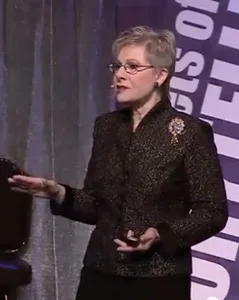
Patricia Fripp, CSP, CPAE is a Hall of Fame keynote speaker, in-demand executive speech coach, and sales presentation skills expert. Individuals and companies hire Patricia when they want to competitive edge that comes for persuasive presentations.
Contact Patricia Fripp www.fripp.com, pfripp@ix.netcom.com
2 Techniques to Take You to the Next Level
About This Contributor
Patricia Fripp